Can You Use the Apex One Again
And then, if form follows office, than what exactly is the role of enterprise architecture and what class should information technology take? I've been asked that question a few times recently and my answers have consisted of several layers, and so I'd like to distill these different discussions into one reply in this post.
The part of an enterprise (both for-turn a profit businesses and non-profit entities) is to provide value to its customers or constituents. They organize to produce this value in the most efficient mode possible, but what are the areas of the enterprise being architected?
The shape of an enterprise
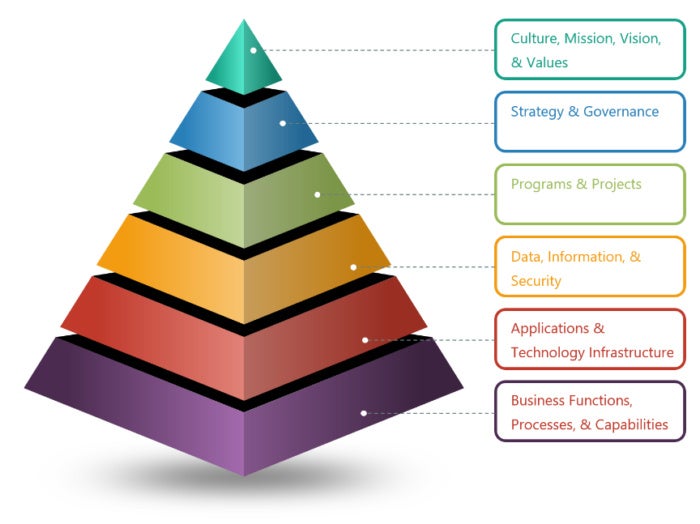
I accept a very holistic view of enterprise architecture, but let me introduce what I consider the shape of the enterprise. Organizations tin can adopt various reporting structures, but that is not what I mean here. When I say shape, I'k referring to the bureaucracy and breadth of the components that make up the enterprise. For me, this shape is an equilateral square pyramid. While triangular or pyramidal representations of business strategy concepts isn't new—many reflect human organizational structures (CEO at the top, followed by direction bands, with employees at the lesser), high-level strategic concepts (e.1000. strategic vision, to goals, to actions), or various other hierarchically bundled ideas—I wanted to share this enterprise architect'south mental model in three-dimensions. Here is my merely-now-titled "Pack Pyramid of EA":
 Ethan Pack
 Pack Pyramid of EA
Let's review, starting with the square floor at ground level. All of the employees, customers, and constituents—the people—are the cadre of an enterprise. This base is the true strength of the firm, enabling or hindering every layer that sits upon it. The business capabilities stretch across the horizontal axis while its functions and processes stripe the vertical axis (as business capabilities are generally fulfilled by integrated processes beyond several organizational functions). As business organization entered the information historic period, organizations digitized paper-based processes into the applications and technology infrastructure shown on the adjacent level. These systems matured and became business-critical, producing increasing volumes of information and information. I place security next to data and information on this third tier equally everything on these 3 levels must exist secured—people, hardware and software, and data and information inputs and outputs. Everything up to this point has pretty much represented the business concern-equally-usual (BAU) and somewhat static enterprise. Now, we continue upward the Pack Pyramid of EA, moving from this actual view to the more than aspirational one.
Programs and projects are the battlefields of change at many organizations with time, scope, and budget pulling with an ongoing, but varying, tension. It is hither where applications and infrastructure are successfully enhanced—or non. This fourth layer affects everything beneath it. The goal of these initiatives is to deliver on strategic objectives, and then that brings us the 5th tier. Strategy and the governance of strategic execution constrain projects and programs; the presence or absenteeism of governance can be the difference between strategic victory or defeat.
A company's culture, mission, vision, and values form the sixth layer—the capstone—of the Pack Pyramid of EA. Say it aloud with me: "Civilization eats strategy for breakfast." Civilisation is a constantly changing dual-country piece of the capstone: the actual culture (which tin exist perceived differently betwixt executives, management, and employees) and the desired culture.
I love the geometric elegance of the equilateral square pyramid; it is the first polyhedron in the collection of Johnson solids, labelled "J1." The 4 side faces converging at the noon is also worth noting. In our pyramid, nosotros consider this the Architectural Point of Effective Due east10ecution, the magical place where everything comes together for outstanding results.
EA as the all-seeing eye
So, where does the enterprise architecture do fit in this pyramid? Much similar the Middle of Providence hovering over the xiii tiers of an unfinished pyramid (representing the original thirteen colonies) on the back of the United States i-dollar nib, the conceptual EA practice also observes the unabridged organisation. EA leaders and teams have to know where the organization has been, currently is, wants to go, and does non want to get in society to arts and crafts fit-for-purpose architectural guidance.
Now, my usage of this imagery is not at all a claim of EA omnipotence, rather my intent is to assert that enterprise architects are (or should be) responsible for the well-being of the entire technology-enabled enterprise "shape" every bit it evolves over time. Enterprise architects are merely stewards of the enterprise landscape. Everyone in the organization should accept a chip of this broad view within them. Much like William Arruda writes in his Forbes.com post, Why Your Team Needs to Focus on the Forest and the Trees , I believe that improvements such as increased strategic understanding and purchase-in, more efficient business operations, improved customer satisfaction, and better financial performance would consequence from more "wood thinking" aslope the mean solar day-to-day whirlwind within our firms.
In the platform-heavy digital economic system, the 'eastward' in enterprise architecture continues evolving into ecosystem. Enterprise architects must look outward, beyond the four walls of the enterprise, and explore the broader manufacture, political, economic, and societal trends which continually reshape the playing field. This broad view helps organizations identify potential innovation opportunities while enabling a smoother transition from a great "concept automobile" to a production-ready "vehicle" with the necessary security, scale, and sustainability.
Build bridges
Accepting the broader and deeper charter for the enterprise compages do, nosotros at present address the organisation structure of this future-ready EA organization.
Offset, nosotros tin better see why EA must report to an executive who is answerable for enterprise-broad concerns. The head of enterprise architecture (or primary architect) directly reporting to the chief executive officer (CEO) may be the panacea, but the chief operating officer (COO), chief information officer (CIO), or chief financial officer (CFO) are logical fits, each offering various pros and cons. I caution on EA reporting into the CIO: this could hinder true enterprise-wide efficacy due to employees' perception and/or the CIO'southward priorities and focus—especially if she is always fighting day-to-twenty-four hour period fires or doesn't comprehend the concern leader demands of the role in the digital historic period. To insulate architecture and strategy from the day-to-day operational dissonance that dampens successful change, EA could be included as function of a multifunctional strategic planning organization reporting to one of these executives.
Next, project direction is a similar "not actually business, not really IT" function. For that reason and the specific duty of executing enterprise initiatives, EA and PMO should be a shared organization, reporting into the same strategic planning concept. In this model, EA, PMO, and finance leaders can help ascertain a proper arroyo to budgeting, resource allocation, and other areas of agile financial direction. This sort of handling can help organizations motion from a sometime budgeting process into a much more than adaptive planning posture.
Third, the EA governance model must be a part of the larger corporate governance structure. Information technology needs to characteristic a continuous feedback loop to and from executive teams, boards of directors, and business leaders. This allows for more rapid responses to shifts in strategy and mitigates confronting details getting lost in translation. The EA team must collaborate with business unit leaders to shape the roadmap and prioritize and manage demand. Architects should continue seeking a deeper agreement of their organizations' value streams and business processes. Agile execution can carry the risk of developing solutions with little or no reusability, proving costlier and more than hard to maintain in the long run, so the technology architecture needs appropriate definitions of standards and alter control.
4th, the enterprise compages team needs to accept both a "core team" consisting of full-time architects and an "extended team" consisting of business concern and technology stakeholders throughout the system. The core team can listen the "architectural library" and tactics while the extended team helps to spread EA'south relevancy, influence, and adherence.
Finally, advice is critical in earning—and maintaining—an enterprise-wide scope and employee support. In improver to the enterprise architect equally "city planner" metaphor, I've found Gartner's messaging of the enterprise architect equally an "internal direction consultant" to be another very constructive way to assistance co-workers, colleagues, and the public understand the practice.
And so, the enterprise compages role helps lead change, organizes and connects people and engineering science within and around the organization, and pulls everything together to connect at a single point—the organizational "North Star." This function requires a very collaborative construction with enterprise-wide authorisation and support. It likewise calls for more than interest from not-architects to maintain the great pyramid within one'south enterprise.
Source: https://www.cio.com/article/222047/reaching-the-apex.html
0 Response to "Can You Use the Apex One Again"
Post a Comment